
John Robert Swaysland
Rank: Private
Service Number: 2905
Unit: 9th Battalion
Date of Death: 23 July 1916
Memorial: The Australian National Memorial, Villers-Bretonneux, France
John “Jack” Swaysland was the first soldier from Stanthorpe to be killed in action on the Western Front. Aged just 23, Jack, was killed during the Battle of Pozieres in July 1916. His story is one of bravery, mateship, and sacrifice. After Jack was seriously wounded, his friend Bob Adermann found him lying in a shell hole. In an attempt to save him, Bob tried to carry Jack back to a dressing station but was himself killed in the process. The battle of Pozieres was devastating for the Australian forces. At Pozieres, Australians died in greater numbers than anywhere else on the Western Front.
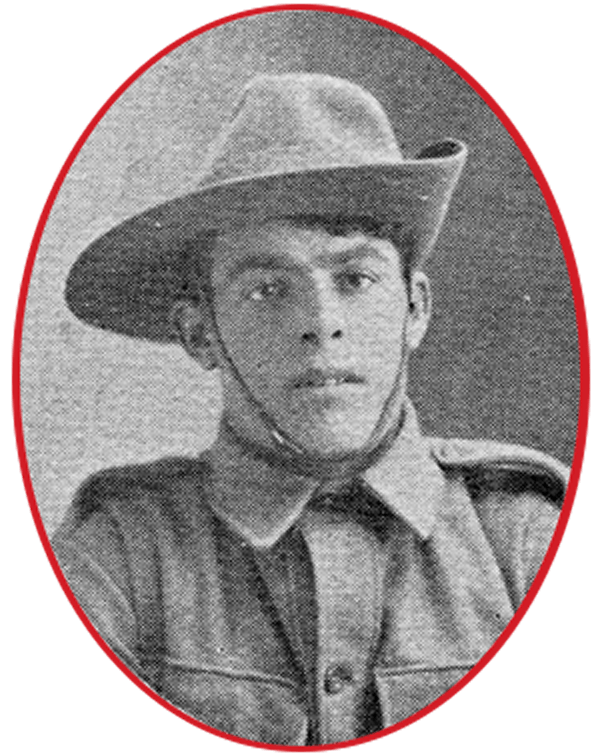
Jack Swaysland was the son of Stephen and Emily Swaysland who lived at “The Retreat”, Thulimbah. Born at Collarenebri, New South Wales, he was a 22-year-old labourer when he enlisted on 10 June 1915 in Brisbane, joining the 9th reinforcements of the 9th Battalion.
Jack left Sydney on 1 September aboard HMAT Ayrshire. He joined his battalion on 19 January 1916 at Tel-el-Kebir, Egypt, a large Australian Imperial Force (A.I.F.) training camp about 110km northeast of Cairo. The 9th Battalion moved from its training camp into position to defend the Suez Canal at Gebel Habieta. In his book, From Anzac to the Hindenberg Line, Norman Harvey described the conditions at Gebel Habieta:
rations and supplies were scarce and the blowing sand meant the Australian trenches had to be continually dug out (Harvey 1941,98).
In March 1916, General Birdwood, Commander of I Anzac Corps, announced the Australian infantry were to leave Egypt and join the fighting on the Western Front. Jack sailed from Alexandria on 27 March with the 9th Battalion arriving in Marseilles six days later. The Australians headed north by train from Marseilles, and after 2½ days arrived in Belgian Flanders at Godewaersvelde. According to Harvey, the 9th Battalion moved south of Armentieres into a sector known as “the nursery” where they were to become accustomed to conditions on the front line for what lay ahead (Harvey 1941,109).
READ BORDER POST ARTICLE
The Battle of the Somme began on 1 July with an attack by British and French infantry divisions either side of the River Somme in northern France. Despite some early gains, the attack ultimately failed. After three successive failed British attacks at Pozieres, the Australian 1st Division was called up to lead the next attack. The 9th Battalion left Godewaersvelde on 10 July and moved into position the following day on the Somme at Naours, about 15km north of Amiens.
The Australian 1st Division began its attack on Pozieres on 23 July. The 9th Battalion’s objectives were to capture Pozieres Trench, just south of the village, the German second line of trenches, and the south-eastern side of the road from Bapaume to Albert. In the four days of hard fighting that followed, the 9th Battalion captured all of these objectives and together with the other battalions of the 1st Division received the congratulations of Field Marshall Sir Douglas Haig, General Birdwood, and General Gough (Wrench 1985, 132). But the cost had been high: 57 men killed, 271 wounded, and another 65 missing.
Jack Swaysland was first reported missing in action at Pozieres. On 4 August, he was declared killed in action on 23 July 1916.


Corporal Alexander Villiers told the Red Cross on 24 August:
I am corporal of the Lewis Gun Section, to which Swaysland and Aldermann [sic] belonged. Both men were wounded by shrapnel from a bomb and were being carried to a shell hole for security; but both were hopeless cases and were eventually left. The next day Swaysland’s identification disc was brought in but not Aldermann’s [sic]. C.Lowe of the L.G.S. was an eyewitness of what happened I was not.
Corporal William McIntyre, of Brisbane, shed new light on these events when he wrote to the Red Cross regarding the death of Private Robert Adermann:
I was very sorry to lose him as he was all that a soldier should have been. At the time of his death he was on a detached post and the night before the general advance at Pozieres his team were detailed to take a strong post along with some bombers. A friend of his J.Swaysland was hit and in trying to get him to cover Adermann himself was killed. He was buried in the field as was all the other dead.
This account was corroborated by No. 2791 J.M. Cleary, who as an eyewitness, wrote for Private Robert Adermann’s Roll of Honour:
He risked his life trying to carry Pte. Swaysland whom he found in a shell hole seriously wounded to the dressing [station] through heavy machine gun firing and was so killed.
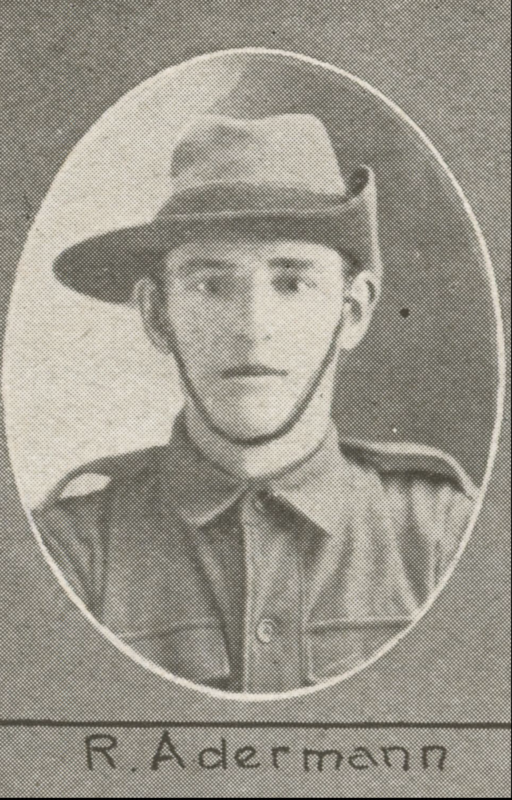
Robert Adermann was born in Toowoomba, the son of Carl “Charles” and Emilie Adermann. Robert had four brothers and a sister. One of his brothers was Sir Charles Frederick Adermann K.B.E., a Federal politician who represented the seat of Maranoa 1943-49 and then Fisher 1949-72. Robert was a 26-year-old farmer, of Kingaroy, when he enlisted two days before Jack Swaysland in June 1915.
The Stanthorpe Border Post ran a short article on 1 September. It read:
We regret to confirm our previous report of the death of Private Jack Swaysland. The young soldier was killed in action in France on the 23rd July.
On 11 September, the Officer in Charge of Base Records wrote to Littleton Groom, the Member for Darling Downs in the House of Representatives, giving updated details on a number of missing and wounded men. One of those mentioned was Jack. The letter states:
No. 2905 Private J.R. Swaysland, 9th Battalion, who was previously reported as missing on 22/7/16, is now reported by cable message dated London, 21/8/16, as having been killed in action on 23/7/16. Next-of-kin is shown as Mr. S. Swaysland (father) Stanthorpe. Qld.
The Secretary of the Stanthorpe Red Cross Society wrote to Base Records on 15 May 1917:
Re 2905 Private Swaysland deceased. I have been approached by his father who except for official notification of his son’s death, has had no report at all from the Authorities although he has written several times. I have been fortunate in seeing reports through the Red Cross Information Bureau, and as Mr. Swaysland is anxious to secure as a memento some of his boys effects. Could you kindly forward anything you may have to me and I shall gladly hand over to Mr. Swaysland.
Stephen Swaysland received his son’s personal effects in August 1917: a torch, pocket book, testament, photos, brush, tea glass, two books, matchbox, belt, badges, brush, and a pencil. Upon receiving these, Swaysland wrote a letter to Base Records:
I have to complain amongst the effects I have not received presentation wristlet watch, fountain pen, and other things which should have been amongst the effects. But most of all I would treasure the watch. Kindly asking if same can be traced. His name being inscribed on the inside of back cover. On 16 June 1921, Base Records Melbourne wrote to Swaysland to say:
I regret very much that, notwithstanding the efforts of our Graves Services Unit, we have so far been unable to obtain any trace of the last resting place of your son the late No. 2905 Private J.R. Swaysland.
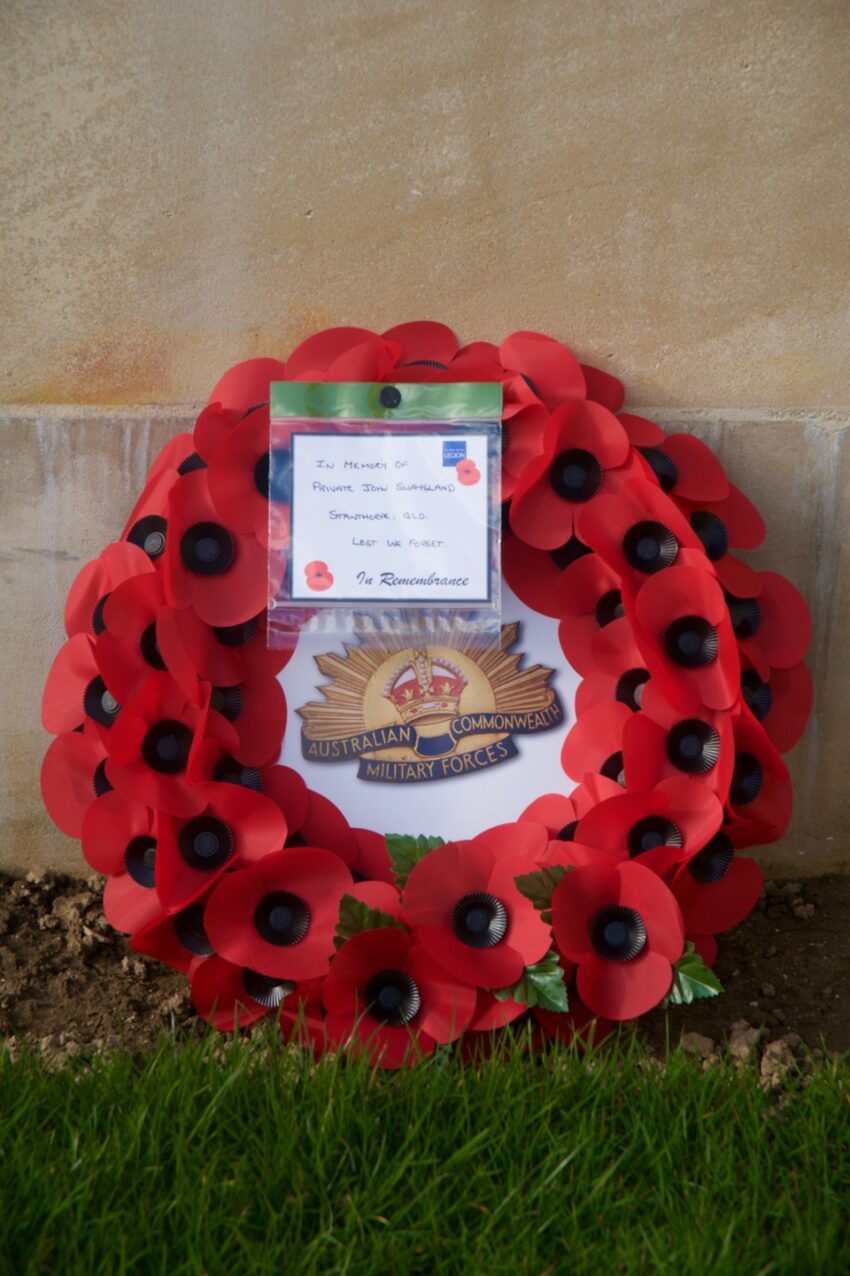
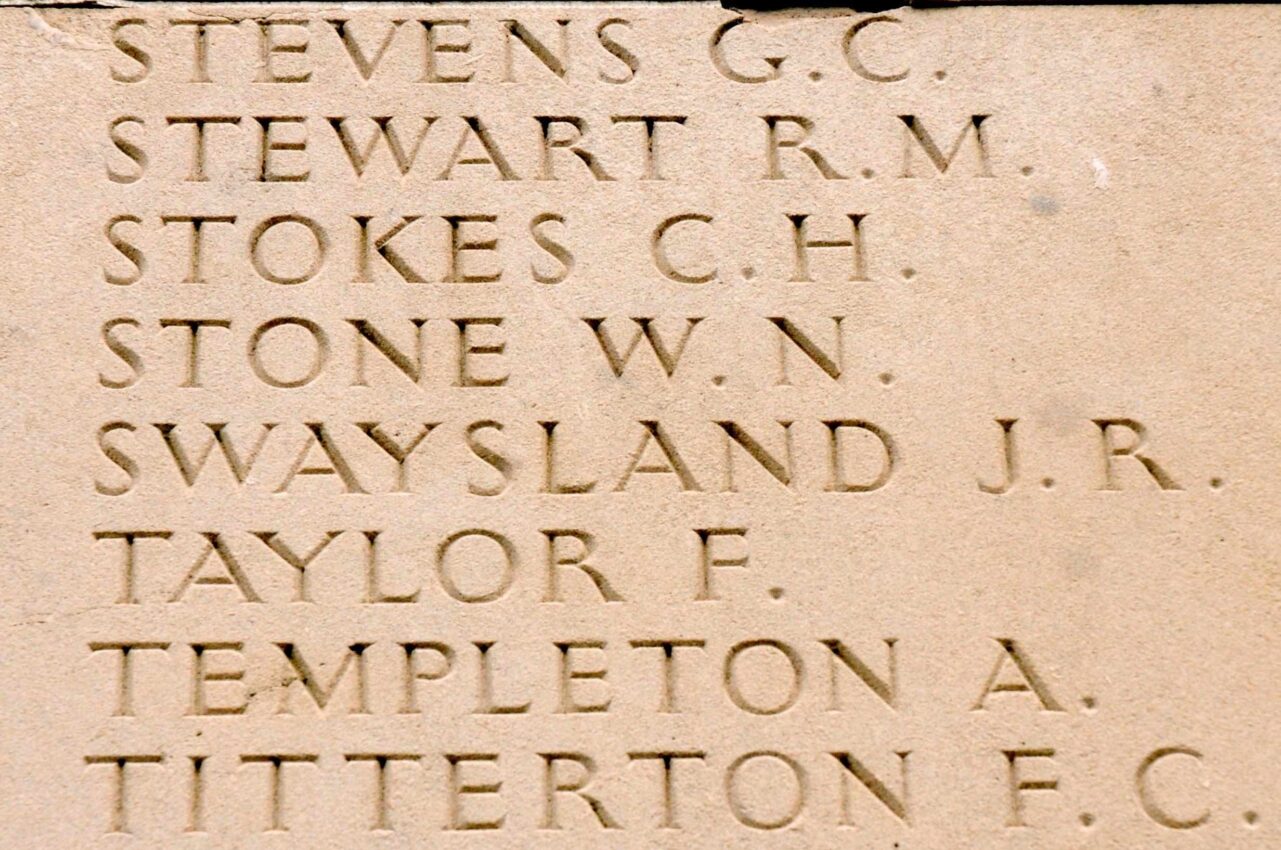
Both Private John Swaysland and Private Robert Adermann have no known grave but are remembered with honour on the wall of the Australian National Memorial, Villers-Bretonneux, France.
Paddy Hyde, another soldier from Stanthorpe, also died at Pozieres, six days after Jack Swaysland. The Battle of Pozieres lasted six weeks and took the heaviest of tolls on I Anzac Corps. The three Australian divisions that fought there suffered over 23,000 men killed or wounded for a gain of some 1½ miles.
References
Harvey, N.K. (1941) From Anzac to the Hindenburg Line. The History of the 9th Battalion A.I.F.1st edition. Brisbane. William Brooks and Co.
Wrench C.M. (1985) Campaigning with The Fighting 9th (In and out of the line with the 9BN A.I.F.) 1914-1919. 1st edition. Brisbane. Boolarong Publications.
Photographs
Photograph of Private John Swaysland. John Oxley Library, State Library of Queensland Image No. 702692-19150925-s0025-049, p. 25 of The Queenslander Pictorial, supplement to the Queenslander, 25 September, 1915.
Australian National Memorial, Villers-Bretonneux, France.
The Village of Pozieres.
Photograph of Private Robert Adermann. John Oxley Library, State Library of Queensland Image No. 702692-19150828-s0022-001, p. 22 of The Queenslander Pictorial, supplement to the Queenslander, 28 August, 1915.